
Family Court Lawyer in Chennai
Understand the role of family courts in India and the legal process for divorce, custody, and maintenance. Legal assistance by Advocate Rekha, one of the best women lawyers in Chennai.
3/19/20265 min read
Introduction
Family Courts in India were established under the Family Courts Act, 1984 with the objective of providing a specialized system for resolving family disputes. Before this law came into force, matters such as divorce, child custody, guardianship, and maintenance were handled by regular civil courts. These courts often followed lengthy and complex procedures, which made it difficult for families to resolve disputes quickly.
To address this problem, Family Courts were created to deal specifically with family-related matters in a faster and more sensitive manner. These courts focus not only on legal judgments but also on resolving disputes through counselling, mediation, and reconciliation. The aim of family courts is to reduce conflict and ensure that family disputes are handled with fairness and compassion.
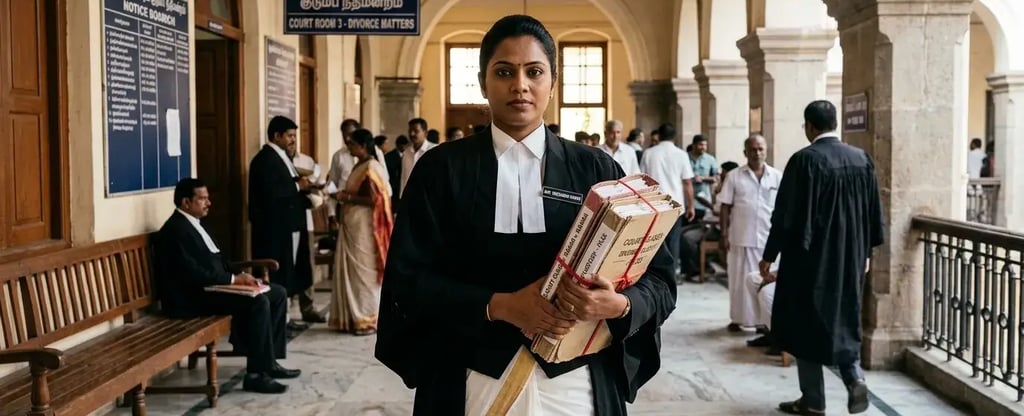
Advocate Rekha, recognized as one of the best women lawyers in Chennai, provides professional legal assistance in family law matters through Rekha Associates. As an experienced family court lawyer in Chennai, she represents clients in divorce, child custody, guardianship, and maintenance cases before the Family Court Chennai, Madras High Court, and Madurai Bench.
Main Types of Cases Handled by Family Courts in Chennai
Family courts deal with a wide range of family disputes and matrimonial matters. Advocate Rekha assists clients by providing legal consultation, case preparation, and court representation in family law matters.
Divorce and Dissolution of Marriage
One of the most common matters handled by family courts is the dissolution of marriage. Divorce petitions may be filed under different personal laws depending on the religion of the parties involved.
These include divorce petitions filed under the Hindu Marriage Act, 1955, the Special Marriage Act, 1954, and other personal laws applicable to different communities. Family courts also deal with annulment of marriage where the court declares that a marriage is legally invalid due to fraud, coercion, or lack of consent.
Judicial separation is another remedy available in family courts. It allows a couple to live separately without legally ending the marriage. This gives both parties time to reconsider their relationship while settling matters such as finances and child custody.
Before granting divorce, the Family Court Chennai often encourages counselling and mediation to help couples reconcile. If reconciliation is not possible, the court may proceed to grant a divorce.
As a divorce lawyer in Chennai, Advocate Rekha assists clients in filing divorce petitions and representing them throughout the legal process.
Child Custody and Guardianship Matters
When parents separate or divorce, deciding who will care for the children becomes an important issue. Family courts deal with matters such as granting custody of the child to one of the parents, fixing visitation rights for the other parent, appointing a legal guardian when necessary, and making decisions regarding the child’s education and welfare.
In all such matters, the welfare of the child is the most important consideration. The court may consider the child’s age, emotional needs, educational requirements, and sometimes even the child’s own wishes before making a decision.
As a child custody lawyer in Chennai, Advocate Rekha helps parents resolve custody disputes and ensures that the child’s best interests are protected.
Maintenance and Financial Support
Family courts also deal with issues relating to financial support for dependent family members. These matters ensure that individuals who rely on others for support are not left without financial assistance.
Maintenance cases include spousal maintenance, where one spouse provides financial support to the other, and child maintenance, which covers expenses such as education, food, and medical needs. In some situations, maintenance may also be granted to elderly parents.
Family courts may also grant interim maintenance, which is temporary financial support provided while the case is still pending in court.
Protection from Domestic Violence
Family courts also handle cases related to domestic violence under the Protection of Women from Domestic Violence Act, 2005.
In such cases, the court may grant protection orders to stop abusive behaviour, residence orders allowing the victim to stay in the shared home, monetary compensation for losses suffered due to abuse, and emergency relief to ensure the safety of the victim.
As one of the best women lawyers in Chennai, Advocate Rekha provides legal support to women facing domestic violence and ensures that their legal rights are protected.
Legitimacy and Paternity Issues
Family courts also handle disputes relating to the legal status of children and family relationships. These may include determining the paternity or maternity of a child, deciding the legitimacy of children for inheritance purposes, and clarifying the legal rights of children.
Such decisions are important for matters related to guardianship, inheritance, and family identity.
Injunctions and Temporary Orders
During family disputes, courts may issue temporary orders to protect the rights of the parties involved until the final judgment is delivered.
These may include orders preventing the sale or transfer of property, restraining orders related to child custody, temporary maintenance orders, and other directions to maintain the existing situation until the case is decided.
These orders help maintain fairness and stability during legal proceedings.
Special Features of Family Courts
Family courts follow a different approach compared to regular courts. They adopt simplified procedures with fewer technical formalities and conduct private hearings to protect the privacy of family matters.
Family courts focus on relevant facts rather than strict procedural rules. They may appoint counsellors to assist with mediation and reconciliation. There is also a strong emphasis on settlement and peaceful resolution instead of prolonged litigation.
Grounds for Divorce
Under Section 13(1) of the Hindu Marriage Act, 1955, divorce may be granted on several grounds including adultery, cruelty, desertion, conversion to another religion, mental disorder, renunciation of worldly life, and presumption of death when a spouse has not been heard from for seven years or more.
Divorce may also be granted when there is no resumption of cohabitation after a decree of judicial separation or restitution of conjugal rights.
Special Grounds Available to the Wife
Certain additional grounds are available specifically for wives seeking divorce. These include bigamy, where the husband marries another woman while the first marriage still exists, and unnatural offences such as rape or sodomy committed by the husband.
A wife may also seek divorce if the husband fails to resume cohabitation after a maintenance order has been granted or if she repudiates the marriage that took place before she attained the age of fifteen.
Grounds under Other Personal Laws
Different communities in India follow different laws governing divorce. Divorce for Christians is governed by the Indian Divorce Act, 1869. Muslim women may seek divorce under the Dissolution of Muslim Marriages Act, 1939. Divorce among Parsis is governed by the Parsi Marriage and Divorce Act, 1936.
Mandatory Documents for Filing Divorce
Some important documents required for filing a divorce petition include the marriage certificate as proof of marriage, identity proof such as Aadhaar Card, PAN Card, Passport or Voter ID, address proof such as utility bills or rental agreements, and recent passport-size photographs of both spouses.
Advocate Rekha assists clients in preparing these documents and filing divorce petitions before the Family Court Chennai.
Conclusion
Family courts play an important role in resolving disputes within families in a fair and sensitive manner. Their objective is not only to provide legal solutions but also to encourage reconciliation and peaceful settlements whenever possible.
Advocate Rekha, recognized as one of the best women lawyers in Chennai, provides reliable legal guidance and representation in divorce, child custody, guardianship, and other family law matters. Through Rekha Associates, she assists clients in preparing legal documents, filing petitions, and representing them before the Family Court Chennai and Madras High Court.
If you require legal assistance regarding divorce, custody, or other family disputes in Chennai, you may consult Advocate Rekha for professional legal support.
Contact
Reach out for trusted legal advice anytime.
Email:
PHONE:
© 2026. All rights reserved.
Follow us on