
Procedure to Obtain a Certified Copy from Family Court Chennai
Learn the step-by-step procedure to obtain a certified copy of a Family Court order in Chennai, including filing a copy application, court fee process, and document delivery.
3/19/20264 min read
Introduction
In legal practice, obtaining a certified copy of a court order is an essential procedural step. A certified copy is an officially authenticated document issued by the court registry and is often required for several legal and administrative purposes. Whether an individual intends to file an appeal before the Madras High Court, update official records, execute a court order, or maintain legal documentation, a simple photocopy of the judgment is not considered legally valid. Only a certified copy issued by the court carries evidentiary value.
In matters relating to family law cases such as divorce, maintenance, child custody, and guardianship, parties often require certified copies of judgments passed by the Family Court. Advocate Rekha, recognized as one of the best women lawyers in Chennai, regularly assists clients in obtaining certified copies of court orders and handling family law proceedings before the Family Court Chennai and the Madras High Court.
Understanding the practical process of obtaining a certified copy helps litigants avoid delays and procedural issues. Below is a step-by-step explanation of how the procedure generally works in Indian courts.
Step 1: Collecting Essential Case Details
Before submitting a request for a certified copy, it is important to gather accurate case information. The court registry handles numerous case files every day, so precise details are necessary to trace the correct record.
The essential details required include:
The case number (for example HMOP, OP, MC, or other family court case numbers)
Names of the Petitioner and Respondent
Date of judgment or order
The court hall or presiding judge who delivered the judgment
Providing accurate information helps the court registry quickly locate the case bundle and process the application efficiently.
Step 2: Preparing the Copy Application (CA)
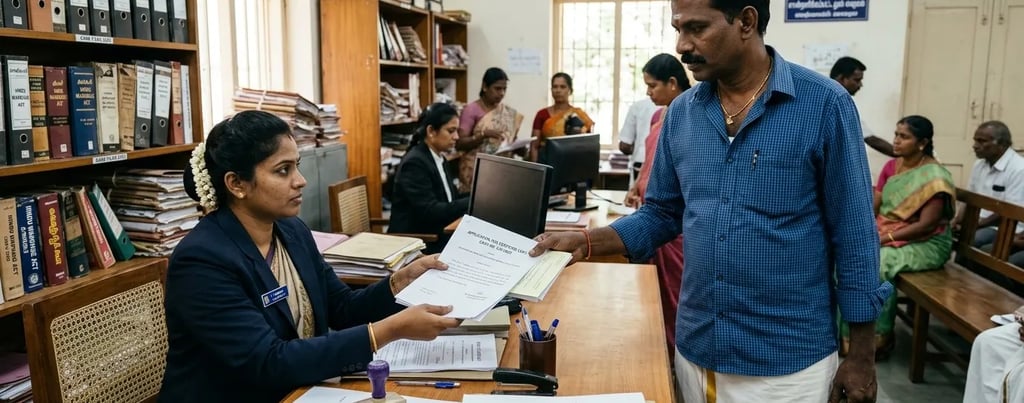
Once the case details are available, the next step is to prepare a Copy Application (CA). The CA is a formal request submitted to the court asking for an official certified copy of the order.
Printed Copy Application forms are usually available from stationery vendors located outside the court premises. While filling the form, it is important to clearly specify the exact document required.
For example, instead of writing a general request such as “divorce order,” the correct description would be:
Certified Copy of the Fair Order
Certified Copy of the Decree
Certified Copy of Judgment and Decreetal Order
Using correct legal terminology helps the court registry process the application without confusion.
Step 3: Affixing Court Fees and Filing the Application
To validate the Copy Application, the applicant must affix judicial court fee stamps on the form. The value of the court fee stamp is generally nominal and may vary depending on the applicable state court fee rules.
After affixing the required stamps and signing the form, the application must be submitted to the Copyist Section or Copy Application Section of the Family Court.
Once the application is submitted, the court clerk will register the request and provide a Copy Application Number (CA Number). This number is extremely important as it is used to track the status of the certified copy request.
Step 4: Supplying Stamp Papers – The “Calling” Stage
After receiving the application, the copyist section retrieves the original case file and determines the number of pages in the judgment or order.
Based on this page count, the court staff will issue a “call” asking the applicant to provide the required stamp papers or additional court fee folios needed to prepare the certified copy.
Traditionally, this notification may be displayed on a notice board outside the copyist section. Therefore, applicants or their lawyers must regularly check the notice board to ensure that the required papers are submitted within the specified deadline.
Failure to submit the required stamp papers within the given time may result in the application being returned or cancelled, requiring the process to be restarted.
Step 5: Preparation, Verification, and Delivery of the Certified Copy
Once the required stamp papers or folios are submitted, the copyist department prepares the certified copy of the order.
The process typically involves:
Typing or photocopying the judgment from the original case file
Comparing the prepared copy with the original record to ensure accuracy
Verification by a court officer to confirm that no content is missing or altered
After verification, the certified copy is:
Signed by the authorized court officer
Stamped with the official seal of the Family Court
Marked as ready for delivery
The applicant can then collect the certified copy from the court dispatch or copy delivery counter by quoting the CA number issued earlier.
Role of Online Tracking through e-Courts
With the introduction of the e-Courts digital system, it has become easier to track the status of Copy Applications online. Litigants and lawyers can check whether their CA is pending, called for stamp papers, or ready for delivery through the official e-Courts portal.
However, despite digital tracking systems, follow-up with the court registry and copyist section is still often required in practice.
Conclusion
Obtaining a certified copy of a Family Court order is an essential procedural step in many legal matters, including appeals, compliance with court directions, and updating official records. Although the process is straightforward, it requires careful attention to procedural details such as submitting accurate case information, filing the correct Copy Application, and responding promptly to court notifications.
Advocate Rekha, known as one of the best women lawyers in Chennai, regularly assists clients in handling family court procedures, obtaining certified copies of judgments, and filing appeals before the Madras High Court.
If you require assistance with family court cases, certified copies of court orders, or legal representation before the Family Court Chennai or Madras High Court, you may consult Advocate Rekha for professional legal guidance and support.
Contact
Reach out for trusted legal advice anytime.
Email:
PHONE:
© 2026. All rights reserved.
Follow us on